



 A documentary about the Karoon River has highlighted one of the Middle East's most serious environmental problems, which has developed into a major crisis as a result of neglect by the Iranian government and is threatening the lives of thousands of Ahwazi Arabs (
right-click here and save to view film
).
A documentary about the Karoon River has highlighted one of the Middle East's most serious environmental problems, which has developed into a major crisis as a result of neglect by the Iranian government and is threatening the lives of thousands of Ahwazi Arabs (
right-click here and save to view film
).
The Karoon River runs through the predominantly Arab city of Ahwaz City in the south-west Iranian province of Khuzestan (Al-Ahwaz), providing an important source of irrigation and drinking water. However, the failure to treat raw industrial and human waste being pumped into the river along with the government's refusal to invest in de-siltation has created a hazardous environment.
 Disruptions to water supplies force many Ahwazis to rely on contaminated water from the Karoon, which contains high levels of human sewage and industrial pollutants. Fishermen are reporting outbreaks of disease in fish and a sharp decline in fish numbers, indicating that Iran's mismanagement of water resources has devastated river life.
Since the 1979 Iranian revolution, the Karoon has faced more than 400 incidents of serious contamination. Last year, the government paid 700 billion rials (US$76.5 million) for a pistachio cultivation programme in Rafsanjan province, but just 100 billion rials (US$10.9 million) for water management in Khuzestan province.
Siltation of the river also means that during heavy rains, large areas of farmland are flooded with the contaminated water, killing livestock and ruining crops which the indigenous Ahwazis rely on for a living.
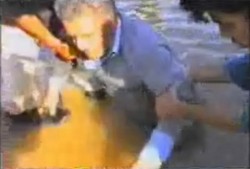 Added to the problem is the government's river diversion programme, which involves the construction of a series of dams to take water to provinces such as Yazd where water is scarce. The result is that when the floods recede, farmers have to deal with drought conditions. The Ahwazis are in a perpetual cycle of flood and drought, exacting a huge toll on their livelihoods and health.
Anger over water management has fuelled anti-government sentiment among Ahwazi Arabs. In the documentary, one Arab tells the interviewer: "We went to the provincial governor, but the government doesn't care. They are feeding the Palestinians, but forgetting about us." Another says: "If we are Israelis, then kill us. But we are Iranians, so why are we treated like dogs?"
 The level of anger has prompted a rare display of opposition to the government from local members of parliament, who are normally loyal to the regime. In December 2005, Khuzestan's Majlis members lodged a petition for the impeachment of Energy Minister Parviz Fattah (
click here for report
).
The level of anger has prompted a rare display of opposition to the government from local members of parliament, who are normally loyal to the regime. In December 2005, Khuzestan's Majlis members lodged a petition for the impeachment of Energy Minister Parviz Fattah (
click here for report
).
Labels: environment , poverty
permalink
keywords: ahvaz ahwaz ahwazi arabistan khuzestan khuzistan khuzestani arab arabistan iran iranian human rights security oil news ahmadinejad ethnic cleansing
.......................................................................................
