



 By Redha Amini and Ali Bani Torfi
The Arab-majority province of Khuzestan is suffering from long-term political negligence and economic deprivation, despite being rich of oil and gas and serving as a hub for industrial and exoports, according to the Farsi language Karoon newspaper.
In an article entitled "Khuzestan is the richest province, but ..." published on 6 May, the newspaper states that out of a population of 4.35 million, 1.46 million live in the countryside where there are problems of under-employment while official unemployment in the province is up to 20 per cent. Despite the province's fertility and potential in agriculture, farms are suffering from a lack of investment and are under-performing, leading to rural poverty.
Dr Nasser Soudani, the parliamentary representative for Ahwaz City, was forced to concede the problems with unemployment in the region. He also highlighted the problem of drinking water, which is contaminated and regularly cut off despite the region's large rivers and reservoirs. He laid the blame on the demand for water from sugar cane plantations, which were established after the government confiscated thousands of hectares of land from Ahwazi Arab farmers.
Ahwazi NGOs believe that poverty is far worse than the government is prepared to admit, with unemployment estimated at up to 50 per cent in Arab-populated cities such as Abadan and Mohammerah (Khorramshahr). Iranian politicians are also unwilling to address the root cause of water shortages: the diversion of water to Isfahan and Rafsanjan.
Soudani identified three main problems in Khuzestan: "first there is insufficient development spending, second there is no developed and comprehensive plan and third there is no effective management ... The region's level of educational attainment is lower than other regions and the Education Ministry and the Ministry of Science, Research and the Environment should pay special attention to this region to tackle these problems."
He also talked of an outbreak of untreatable skin and blood illnesses which he said were getting out of control.
Labels: environment , poverty
permalink
keywords: ahvaz ahwaz ahwazi arabistan khuzestan khuzistan khuzestani arab arabistan iran iranian human rights security oil news ahmadinejad ethnic cleansing
.......................................................................................
24 April, 2007

The US and Israel have faced international condemnation for the construction of separation walls in the West Bank and Baghdad, but the world continues to turn a blind eye to Iran's construction of walls around Arab ghettoes in Ahwaz.
 Separation walls in Ahwaz such as the one pictured above are designed to segregate the indigenous Arab population from wealthier non-Arab districts built on land confiscated from Arabs. In 2003, the regime bombed hundreds of homes in the Arab populated Sepidar district of Ahwaz City, displacing thousands of indigenous Ahwazi Arabs to make way for homes for ethnic Persians. Ethnically exclusive residential developments such as Shirinshahr and Ramin have been built in recent years to house Persians from Yazd and Fars provinces who have been brought into the area to take up jobs denied to Arabs (
click here for details
).
Separation walls in Ahwaz such as the one pictured above are designed to segregate the indigenous Arab population from wealthier non-Arab districts built on land confiscated from Arabs. In 2003, the regime bombed hundreds of homes in the Arab populated Sepidar district of Ahwaz City, displacing thousands of indigenous Ahwazi Arabs to make way for homes for ethnic Persians. Ethnically exclusive residential developments such as Shirinshahr and Ramin have been built in recent years to house Persians from Yazd and Fars provinces who have been brought into the area to take up jobs denied to Arabs (
click here for details
).
Following a visit to the traditionally Arab province of Khuzestan in July 2005, UN Special Rapporteur for Adequate Housing Miloon Kothari said that Arab districts endured "very adverse conditions" with "thousands of people living with open sewers, no sanitation, no regular access to water, electricity and no gas connections. I think that the kind of question that arises is, why is that? Why have certain groups not benefited?" ( click here for an interview with Kothari )
He criticised the "attempt being made by the government to build new towns and bring in new people from other provinces", singling out Shirinshah for criticism ( click here to view a documentary on Shirinshahr ).
Nasser Bani Assad, spokesman for the British Ahwazi Friendship Society, said: "Ahwazi Arabs are constantly demonstrating against the separation walls in their homeland and the creation of ethnically exclusive settlements. [ click here to download a video of a demonstration near a separation wall ]
"Iran is enforcing its system of ethnic apartheid by constructing physical barriers. But no-one is listening and there is no media coverage, even when the UN's own experts condemn Iran's actions.
"When the Americans create such barriers in Baghdad for security purposes, there is outrage. When the Iranians create barriers to keep Arabs in their deprived neighbourhoods and prevent social mobility, there is absolute silence from the UN Human Rights Council.
"The Iranian regime's separation walls are no different from the walls the Nazis created around Jewish ghettoes in Warsaw. Time and time again, the Iranian regime is shown to be essentially fascist in nature, yet some still call it a democracy and place their faith in 'reformists'. Fascism cannot be reformed, it can only be overthrown."
permalink
keywords: ahvaz ahwaz ahwazi arabistan khuzestan khuzistan khuzestani arab arabistan iran iranian human rights security oil news ahmadinejad ethnic cleansing
.......................................................................................
19 February, 2007
By Mrs Pooran Saki
Major General Mohsen Rezai, ex-Commander of Iran's elite Islamic Revolutionary Guards Corps has declared that the government is going to take over land in Dashte Azadagan (Bani Torof) in order to use it as a War Museum.
Dashte Azadagan is in the South of Iran and is populated by ethnic Arabs, who lived here before Iran was formed as a state. During the Iran-Iraq war, this area suffered very heavily - the warfare caused massive damage which destroyed most of the city's buildings, and contaminating the air and water with chemical pollution. The region is still shockingly deficient in educational levels and facilities, in health provision and farming resources, but the Iranian government deliberately ignores the problems.
Now a new deception is to be perpetrated on this region - the government state that they want to seize the land in order to control the area, thereby forcing the ethnic Arab citizens to move from their local region to other parts of Iran.
The government carried out this fraud in 1990, when they demanded that all Arab farmers sell their land, compulsorily and at an unjustly low price. The government stated that they were going to grow sucrose in this area. Of course what they really want is to have a monopoly on oil production, which is also known to be there.
Eventually all the farmers left, without their jobs or livelihoods, and without sufficient funds to purchase new lands. Later, the government changed the traditional system of irrigation and polluted the water. This had a catastrophic effect, for many diseases spread around the region, and this led to many ethnic Arabs moving away from their local area.
I, as an Arab from Ahwaz, protest against this underhand exploitation and misappropriation of ethnic Arab, which is impoverishing and driving out the people, and amounts to no less than theft. Why is Mr Razaiye considering a new War Museum? The local population, who have been victims of the war have a greater need to have the region cleared of mines and chemical pollution, and they need to be safe and secure.
Why do we continue to hear about children being killed by mines or dying slowly from mysterious diseases? This is unacceptable. Are these people being made to suffer because of their minority ethnic Arab status?
permalink
keywords: ahvaz ahwaz ahwazi arabistan khuzestan khuzistan khuzestani arab arabistan iran iranian human rights security oil news ahmadinejad ethnic cleansing
.......................................................................................
08 January, 2007
The Director of the Ahwaz Chamber of Commerce has condemned central government policy for hindering industrial development in the Arab-majority Khuzestan province.
According to the Mehr News Agency , the trade official accused state-owned companies of seriously damaging the local economy and the environment. He added that Iranian industries in the province were unable to compete with countries like Turkey on the neighbouring Iraqi market due to excessive government interference, which was undermining the quality of industrial products.
The official's attacks on government policy come just days after a four-day tour of the province by President Mahmoud Ahmadinejad, who claimed that he had endorsed a number of projects for industrial development. The vote of no confidence indicates that few industrialists have faith in the Ahmadinejad administration's economic policies.
Ahwazi Arabs have also accused the government of economic mismanagement and racial discrimination, which have created African levels of poverty in one of the world's most oil-rich regions.
Labels: poverty
permalink
keywords: ahvaz ahwaz ahwazi arabistan khuzestan khuzistan khuzestani arab arabistan iran iranian human rights security oil news ahmadinejad ethnic cleansing
.......................................................................................
22 October, 2006
The number of female pavement sellers in the Arab majority cities of Khorramshahr (Mohamareh) and Abadan is soaring, according to a report published by Iran's Fars News Agency ( download original report ).
According to the news agency's report, the female roadside hawkers are the sole income earnings due to non-payment of wages by state corporations and endemic unemployment and under-employment among Ahwazi Arab men.
The age of female Ahwazi Arab hawkers, who sell food and handicrafts from the villages as well as smuggled goods such as cigarettes and chewing gum, is also falling.
Unemployment among Ahwazi Arabs is running at 50 per cent. Meanwhile, those employed by the state-owned ship-building and port companies are owed months of back-pay, leading to mass demonstrations and strikes ( click here for more information ). Women are now feeling the effects of the employment crisis, but most are illiterate and are only able to work in the informal sector. Yet, the Ahwazi Arab homeland is one of the most oil-rich in the world, with more oil reserves than Kuwait and the United Arab Emirates combined.
High poverty rates are the result of racial discrimination in employment. Ahwazi Arabs are denied jobs, while the government confiscates their land for residential developments to house non-Arabs brought enticed from outside the province with incentives such as zero-interest loans.
Labels: poverty
permalink
keywords: ahvaz ahwaz ahwazi arabistan khuzestan khuzistan khuzestani arab arabistan iran iranian human rights security oil news ahmadinejad ethnic cleansing
.......................................................................................
16 October, 2006
Although mighty rivers such as the Karun and Karkhe flow through the Ahwazi Arab homeland in Khuzestan, many are struggling to find fresh water to survive in the dryer areas of the province.
The Fars News Agency has reported that members of the Sharifat family living in Chah Salem in Omidieh (Al-Amedeya) died due to a lack of clean water. While desperately digging for water, family members inhaled poisonous gas escaping from the ground. Four family members died and three others were hospitalised. A member of the emergency crew sent to rescue the family was also overcome by the fumes.
The news agency's reporter claimed that there was a lack of rescue facilities in the area and that the rural population was suffering drought and severe under-development.
The region is one of the most oil-rich areas in the world, producing around 80 per cent of Iran's oil output. However, absolute poverty rates are around 50 per cent among the indigenous Ahwazi Arab community, which represents the majority of people in Khuzestan (Al-Ahwaz).
Click here for original article
Labels: poverty
permalink
keywords: ahvaz ahwaz ahwazi arabistan khuzestan khuzistan khuzestani arab arabistan iran iranian human rights security oil news ahmadinejad ethnic cleansing
.......................................................................................
14 October, 2006
 An Iranian petrochemical company has denied that the death of thousands of fish off the Mahshahr (Mashour) coast was related to its poor environmental standards.
The pollution is believed to have come from a nearby petrochemical complex run by the Bandar Imam Petrochemical Company (pictured), a subsidiary of the state-owned National Petrochemical Company , and has threatened the livelihoods of impoverished Ahwazi Arab fishermen. However, company managers have denied responsibility. Speaking to the Petroenergy Information Network, the manager of the National Petrochemical Company's environment unit Engineer Mohammad Taghi Jafar Zadeh claimed that further research was needed before a conclusion could be reached on the cause of the pollution. He claimed that if the company was responsible, it would have been a one-off accident rather than a long-term pollution problem ( click here for further information ). However, Qatar has today announced that it will ban imports of seafood from Iran due to radioactive contamination, indicating that marine pollution is a long-term industrial disaster ( click for further information ).
 Reza Vashahi, an Ahwazi human rights activist and researcher who lived for 25 years in Mahshahr, said: "This is not the first time the Mahshahr coast has been affected by pollutants from the petrochemical industry. But the government has always denied that state-owned companies are responsible and has suppressed information on environmental damage. It is well known that all effluent from the petrochemical industry is pumped untreated and unmonitored into the sea. Many local people suffer from high levels of dangerous chemical element in their food, particularly the poor fishermen who depend on fishing for their survival."
Labels: environment , poverty
permalink
keywords: ahvaz ahwaz ahwazi arabistan khuzestan khuzistan khuzestani arab arabistan iran iranian human rights security oil news ahmadinejad ethnic cleansing
.......................................................................................
07 May, 2006
 A documentary about the Karoon River has highlighted one of the Middle East's most serious environmental problems, which has developed into a major crisis as a result of neglect by the Iranian government and is threatening the lives of thousands of Ahwazi Arabs (
right-click here and save to view film
).
A documentary about the Karoon River has highlighted one of the Middle East's most serious environmental problems, which has developed into a major crisis as a result of neglect by the Iranian government and is threatening the lives of thousands of Ahwazi Arabs (
right-click here and save to view film
).
The Karoon River runs through the predominantly Arab city of Ahwaz City in the south-west Iranian province of Khuzestan (Al-Ahwaz), providing an important source of irrigation and drinking water. However, the failure to treat raw industrial and human waste being pumped into the river along with the government's refusal to invest in de-siltation has created a hazardous environment.
 Disruptions to water supplies force many Ahwazis to rely on contaminated water from the Karoon, which contains high levels of human sewage and industrial pollutants. Fishermen are reporting outbreaks of disease in fish and a sharp decline in fish numbers, indicating that Iran's mismanagement of water resources has devastated river life.
Since the 1979 Iranian revolution, the Karoon has faced more than 400 incidents of serious contamination. Last year, the government paid 700 billion rials (US$76.5 million) for a pistachio cultivation programme in Rafsanjan province, but just 100 billion rials (US$10.9 million) for water management in Khuzestan province.
Siltation of the river also means that during heavy rains, large areas of farmland are flooded with the contaminated water, killing livestock and ruining crops which the indigenous Ahwazis rely on for a living.
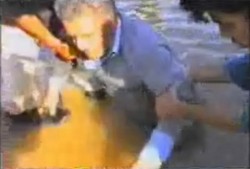 Added to the problem is the government's river diversion programme, which involves the construction of a series of dams to take water to provinces such as Yazd where water is scarce. The result is that when the floods recede, farmers have to deal with drought conditions. The Ahwazis are in a perpetual cycle of flood and drought, exacting a huge toll on their livelihoods and health.
Anger over water management has fuelled anti-government sentiment among Ahwazi Arabs. In the documentary, one Arab tells the interviewer: "We went to the provincial governor, but the government doesn't care. They are feeding the Palestinians, but forgetting about us." Another says: "If we are Israelis, then kill us. But we are Iranians, so why are we treated like dogs?"
 The level of anger has prompted a rare display of opposition to the government from local members of parliament, who are normally loyal to the regime. In December 2005, Khuzestan's Majlis members lodged a petition for the impeachment of Energy Minister Parviz Fattah (
click here for report
).
The level of anger has prompted a rare display of opposition to the government from local members of parliament, who are normally loyal to the regime. In December 2005, Khuzestan's Majlis members lodged a petition for the impeachment of Energy Minister Parviz Fattah (
click here for report
).
Labels: environment , poverty
permalink
keywords: ahvaz ahwaz ahwazi arabistan khuzestan khuzistan khuzestani arab arabistan iran iranian human rights security oil news ahmadinejad ethnic cleansing
.......................................................................................
09 February, 2006
Majid Naasseri-Nejad, a member of parliament representing the Arab populated area of Fallahieah (Shadegan), called on Iran's Oil Minister Kazem Vaziri-Hamaneh to ensure equitable employment practices in the oil-rich Arab-majority province of Khuzestan or face impeachment, according to reports.
Naasseri-Nejad claimed that the Oil Ministry had been placing recruitment advertisements in Shiraz, Isfahan, Mashhad, Tehran and other cities and provinces, but was not actively recruiting from the local Arab population. Some Arab districts are enduring unemployment rates of up to 90 per cent, he claimed.
The practice of moving non-Arabs into the area to fill job vacancies is highly controversial among the impoverished local Ahwazi Arabs. Discriminatory employment practices are rooted in the government's long-term programme of reducing the proportion of Arabs in the province from 70 per cent to around a third through "ethnic restructuring". This was outlined in a top-secret letter written by the then Vice-President Mohammad Ali Abtahi which was leaked last year. The Abtahi letter led to an Ahwazi uprising that was crushed by the regime, killing more than 160 people.
Last month, Portuguese Socialist MEP Paulo Casaca, who heads the European Parliament's delegation to NATO, condemned the Iranian government's policies in Khuzestan as "ethnic cleansing".
Links
Abtahi's secret letter on ethnic restructuring
Paulo Casaca's condemnation of ethnic cleansing against Ahwazis - BAFS, 19 January
Labels: labour , land , poverty
permalink
keywords: ahvaz ahwaz ahwazi arabistan khuzestan khuzistan khuzestani arab arabistan iran iranian human rights security oil news ahmadinejad ethnic cleansing
.......................................................................................
03 February, 2006
The British Ahwazi Friendship Society (BAFS) Arab rights lobbying group has called on the international community to put human rights abuse and economic mismanagement at the top of relations with Iran.
Opposition groups feel that Iran's deteriorating domestic situation has been neglected due to the controversies surrounding the nuclear issue. The first few months of President Mahmoud Ahmadinejad's administration have seen a rise in human rights abuses, while the problems associated with high levels of poverty go unaddressed. However, this is occurring with little or no criticism.
The situation facing the Ahwazi Arabs is particularly bad. Since Ahmadinejad's election last June, human rights groups such as Amnesty International and the Ahwaz Human Rights Organisation have recorded the imprisonment of a large number of peaceful pro-democracy activists, including tribal leaders, imams journalists and teachers (see www.ahwaz.org.uk/reports.html ). Traditional Arabic dress has also been banned following mass public prayers in Ahwaz by Arabs wearing the kuffiyeh in a sign of their resistance to ethnic oppression.
In its latest urgent action, Amnesty International has highlighted the incarceration of two children - 11-year-old Reza Haidari and 14-year-old Kazem Sayahi - following demonstrations during Eid-al-Adha in January. The organisation fears that they, along with scores of other Ahwazi Arabs held in custody, could be facing torture at the hands of Iranian security officials.
BAFS spokesman Nasser Bani Assad said: "Iranians would rather have the huge resources spent on the nuclear programme directed towards poverty alleviation. The Ahwazi Arabs feel particularly aggrieved as the oil revenues generated by land confiscated from them are being squandered on this project. In contrast, legislation to redistribute just a fraction of these revenues to Khuzestan was overturned for a third time in January.
"The regime is building a nuclear plant in earthquake-prone Khuzestan. A containment failure in the event of a natural disaster would devastate not only the Ahwazi homeland but also Kuwait and parts of Iraq. This nuclear facility comes at the expense of Ahwazi Arabs' security and economic well-being.
"Experts say it will be years before Iran can develop nuclear weapons, if that is the regime's intention. But the ethnic cleansing of Ahwazi Arabs from their homeland and their deliberate impoverishment by the regime is happening today. It is an emergency situation that is being eclipsed by the nuclear issue. The international community should not abandon those oppressed by the Iranian government.
"Only a federal democratic Iran that respects human rights can ensure long-term stability and security in the Middle East and prosperity for the people. This is what many Iranians, particularly Ahwazi Arabs, are demanding."
Labels: human rights , poverty
permalink
keywords: ahvaz ahwaz ahwazi arabistan khuzestan khuzistan khuzestani arab arabistan iran iranian human rights security oil news ahmadinejad ethnic cleansing
.......................................................................................
